
He sees systems before they exist. Then he makes them real.
Muhammad Habib on foundations, artificial workforces, and why trust deserves better engineering.
Written by Claire Bennett, English Market Lead.
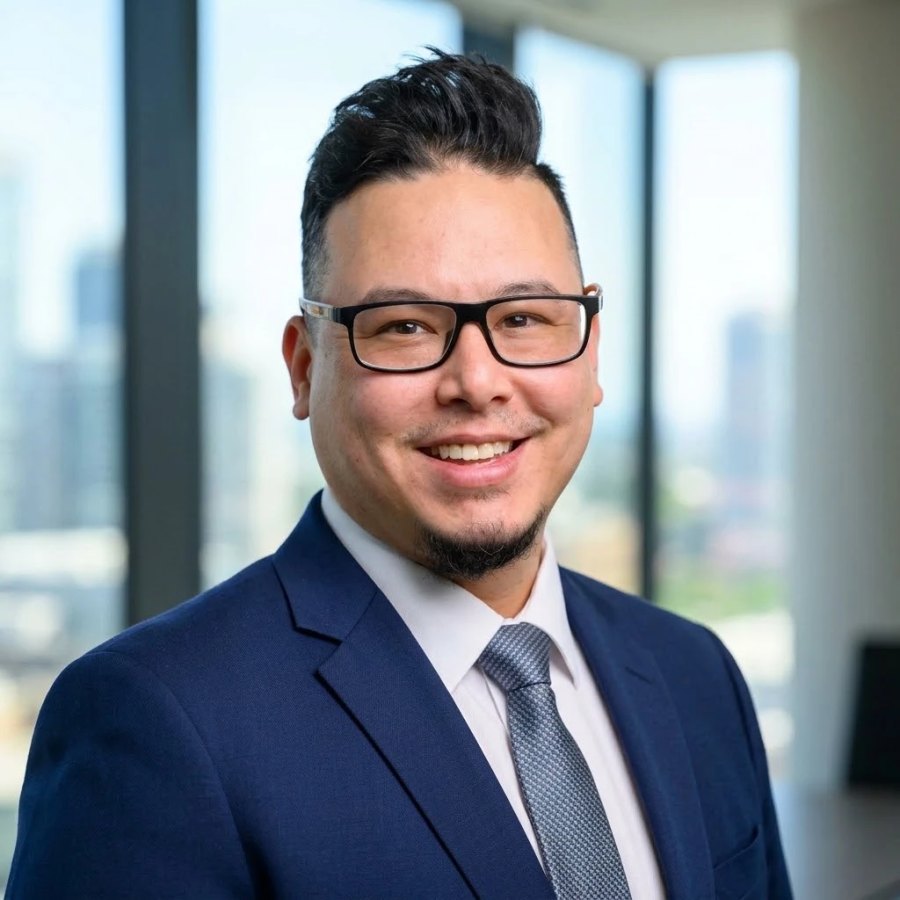
- RoleFounder & Chief AI Officer
- Building AI since2003
- BackgroundSystems engineering, intelligence, AI
- Notable workDubai Healthcare City core infrastructure
- ConceptsRF-TESS sensing array, NEMIS secure network
Muhammad Habib has never described himself as a technologist. He thinks in pictures. Show him a business, a process or a problem and he sees the whole machine at once, every moving part and where it will break. That was true when he was designing the identity structure that unified hundreds of hospitals and clinics in Dubai Healthcare City, and it is true now that he designs workforces made of artificial intelligence. The tools change every few years. The ability to see the finished thing before anyone has built it does not.
It is the part most people get wrong about technology, in his view. They start with a tool and hope a system appears around it. He starts with the picture. What should this firm feel like to run in three years? Who does what, what never needs a human again, and where must a human absolutely stay? Only when that picture is clear does the choice of software matter, and by then it is usually obvious.
It is also why he refuses to put anything clever on a weak foundation. Every failure he has watched, in a hospital network, in an intelligence environment, in a small law office, started underneath, with something basic that nobody owned. Who can get in. Who can see the file. What happens when someone leaves. He sees those cracks the way an architect sees a bad footing, and he will not build above them.
“Most fear of AI is really fear of an employee with no rules. That fear is correct. So we design the rules first and the intelligence second.”Muhammad Habib
On AI his position is simple and unpopular in both camps. It will not replace lawyers or doctors, and it is not a toy. It is a workforce, literally: it needs titles, a manager, limits, a record of what it did, and a person who signs off. Most fear of AI, he argues, is really fear of an employee with no rules, and that fear is correct. So the rules are designed first and the intelligence second. Done that way, it becomes the best hire a firm ever makes.
Law firms came into the picture late, and by accident. Three years ago he went to work inside one and saw from the inside how much of the day disappears into things that have nothing to do with the client. Chasing documents. Waiting on answers. Systems that were paid for and never switched on. Lawyers and doctors are trusted with the most private things people have, precisely because they are not technology companies. He decided that trust deserves the same standard of engineering that banks and governments get, explained plainly enough that a managing partner can act on it without a translator. His test is blunt: if it cannot be drawn on a whiteboard in five minutes, the thinking is not finished.
He holds his own company to the same picture. Legal Gridlock runs on what it sells. Its marketing, research, compliance and support are carried out by a workforce of synthetic intelligences he imagined, named and put to work, each with a title, a manager and a daily report. He saw that company in his head long before it existed. Now it runs every day. That, he says, is the whole job: see it, then make it real.
Muhammad Habib is the Founder and Chief AI Officer of Legal Gridlock, an Atlanta company that builds secure infrastructure and AI workforces for law firms and medical practices.
His career began in the early 2000s as a Microsoft Certified Systems Engineer in the United Arab Emirates, arriving as Dubai was reinventing itself as a digital economy. He specialised in Windows Server environments, designing multi-tier Active Directory structures and hardened domain controllers for multinational organisations. That expertise led to Dubai Healthcare City, the medical free zone launched in 2002, where he helped architect the initial network security parameters, the directory foundation, and the domain controllers that brought hundreds of incoming clinics, research labs and hospitals onto a single secure infrastructure.
He later served as an intelligence officer, work that shaped his conviction that identity, access and the flow of information are the real perimeter of any organisation. During those years he conceived two proprietary signal systems for secure environments: RF-TESS, a passive radio-frequency tomographic array that maps movement inside a structure from ambient wireless reflections without emitting a detectable signal, and NEMIS, a near-field magnetic induction network that carries data through concrete and rock yet falls silent outside the immediate work zone, making outside interception or jamming impossible.
He has been building conversational AI since 2003, starting with chatbots for MSN Messenger, and spent the last three years working inside a law firm before founding Legal Gridlock.
Want the picture drawn for your firm?
A short conversation is enough to see where the foundation is weak and what an AI workforce could take off your desk.